
Your search results will appear here


We've now driven a production Audi e-tron GT on UK roads. Here's how we think it stacks up against the efforts from Porsche and Tesla.
PROS:
+ Blistering performance
+ Great charging speeds
+ High quality, high tech cabin
CONS:
- Shorter range than Tesla Model S...
- ...and much less boot space
- A Taycan feels sweeter to drive
Verdict: The Audi e-tron GT looks superb inside and out, is brutally quick and comes with brilliant charging speeds. We wish it went a bit further between charges, though, and a Porsche Taycan is that bit more fun to drive.
New 2021 Audi RS e-tron GT review: the five-minute read
The new Audi RS e-tron GT is the first fully electric car from the brand to wear the hallowed RS badge, built on the same platform as its stablemate and fellow neck-snapping EV, the Porsche Taycan.
That places it firmly as a rival to Porsche’s electric grand tourer, but it’s also up against stiff competition from the popular Tesla Model S Plaid.
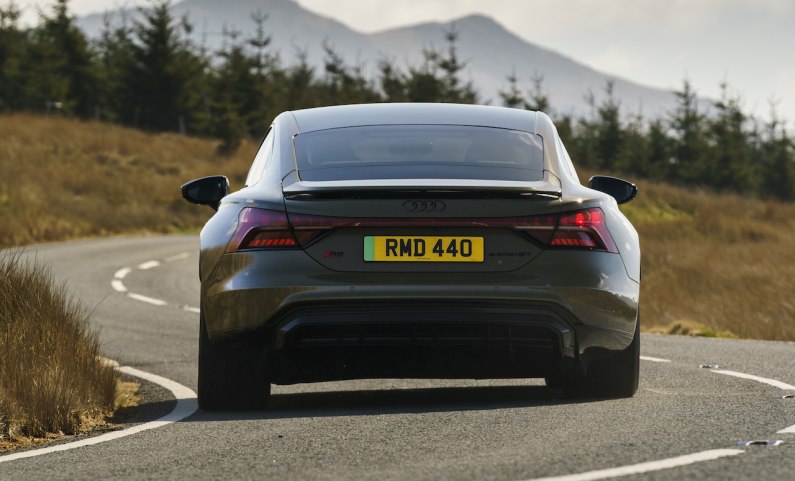
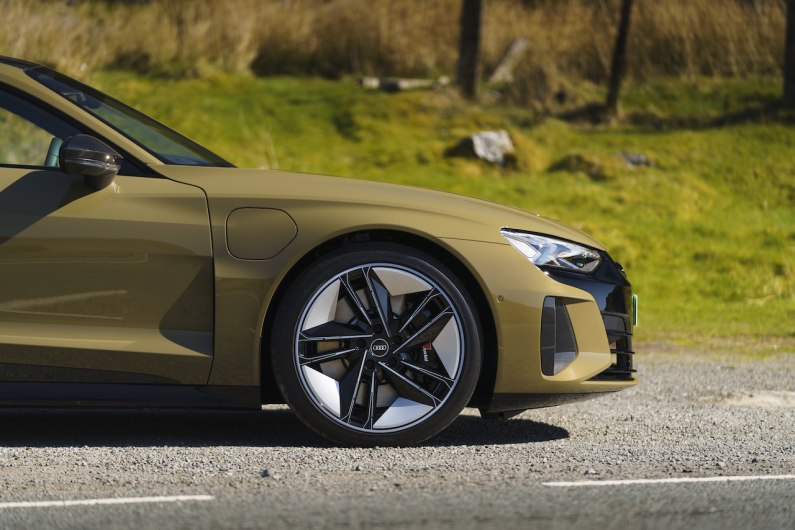
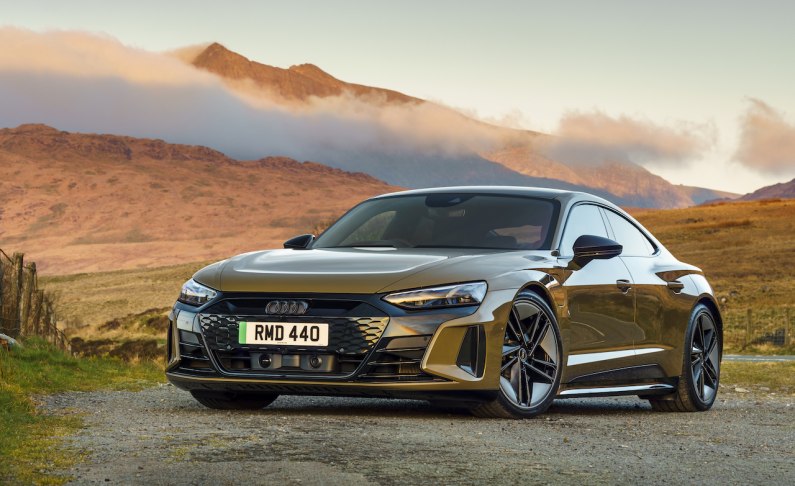
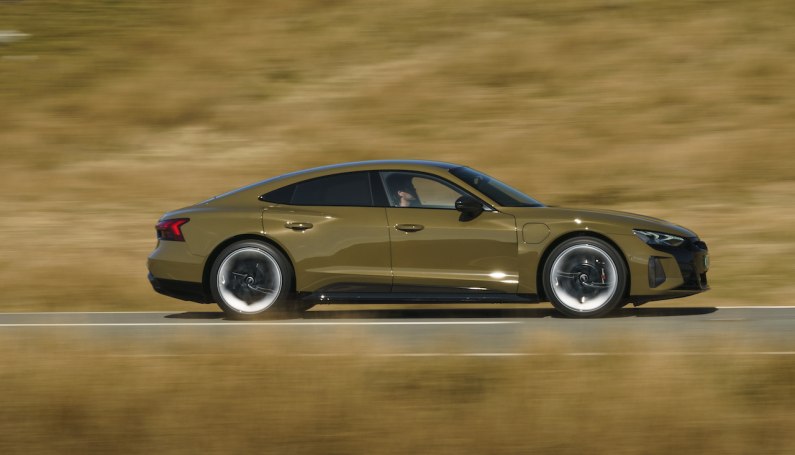
Arguably better looking than both the Tesla and the Porsche, the RS e-tron GT and the ‘standard’ non-RS version, launched at the same time, have an elongated 5-metre body which has clearly been honed and sculpted in the wind tunnel to maximise aerodynamics and reduce drag. It stands just 1.4-metres tall and nearly 2-metres wide: supercar-like dimensions moulded into an aggressive, muscular stance.
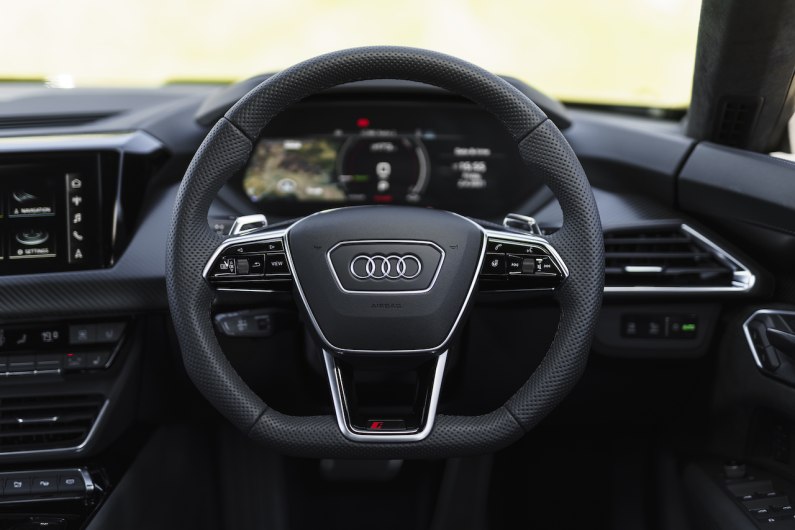
Anyone hoping for something out of the Audi norm from the interior will be disappointed, the cabin of the RS e-tron GT is very similar to that found on Audis which still run on petrol, like the RS7.
That’s no criticism though, as the cabin is incredibly premium and loaded with materials that make you want to run your fingers across surfaces like you’re stroking a Persian cat, and a leather-free design package can be optioned for those who can’t stand the thought of sitting on a former farm animal.
Like all new Audi’s the cockpit focuses heavily on the driver, with the layout and ergonomics all designed with ease of reach in mind, and the build quality is every bit as good as you would expect for a car that costs more than a lot of apartments.
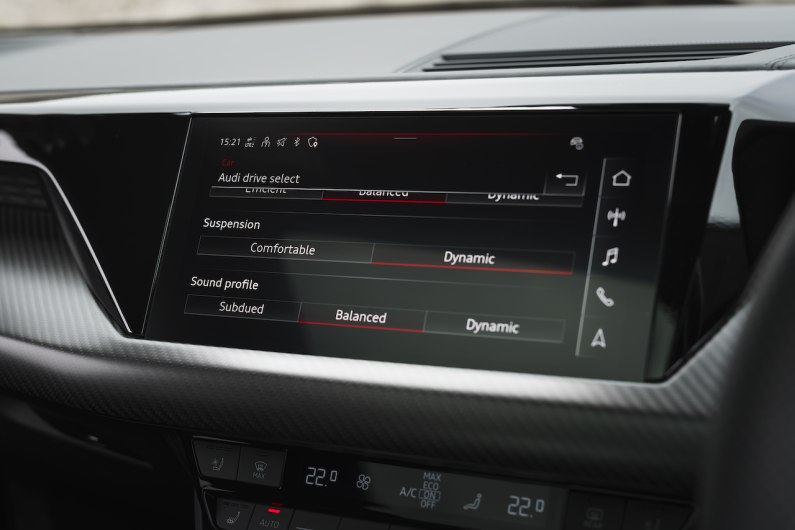
Audi’s tried and tested 10.1-inch infotainment screen is partnered with a 12.3-inch digital driver display. The resolution of both screens is as good as it gets and operating the system is slick and intuitive, plus Apple CarPlay and Android Auto come as standard.
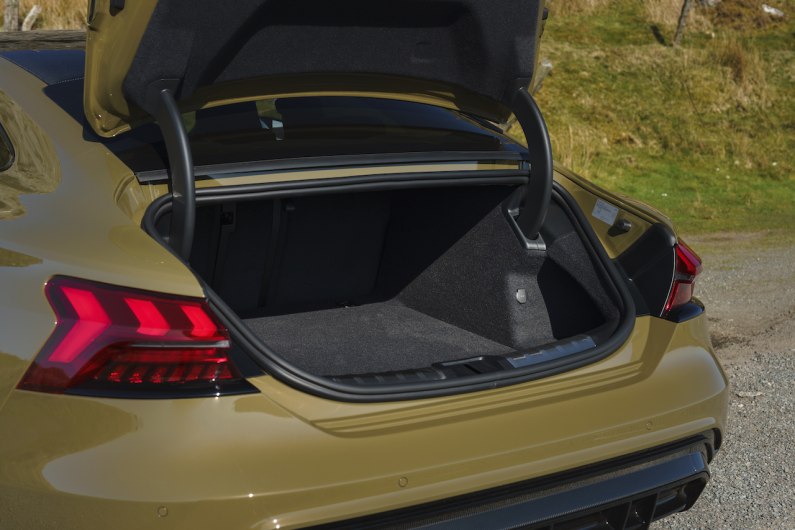
Grand tourers aren’t known for their practicality but because of the lack of engine with the RS e-tron GT you get an 85-litre ‘frunk’ to compliment the 490-litre boot, which, combined, is around the same as the Porsche Taycan but way down on the Tesla Model S’s 894-litres.
Passengers get plenty of legroom though, thanks to scoops made in the battery (which is stored in the belly of the car) to accommodate feet. A neat touch that makes a big difference.
With 0-62mph sprint times of 4.1 seconds for the e-tron GT and 3.3 seconds for the RS model, straight-line performance is massive and unrelenting – in all weathers. Audi’s new electronic Quattro system is bordering on failsafe, it’s hard to think of a car that grips the road quite as well, although a Taycan's steering and cornering behaviour are the more engaging for keen drivers.
The standard model's official range is 298 miles, while the RS comes in at 283 miles, neither of which is close to the 390 miles of the similarly-priced Tesla Model S Plaid. However, fitted with an 86kWh battery (93kWh gross), the Audi can be charged to 80% of capacity in just 23 minutes if you can find a 270kW charge point. Using a standard 11kW charger you will need to leave the RS e-tron GT topping up overnight for a full charge.
So, while the RS e-tron GT loses to the Tesla when it comes to the on-paper stats, it exudes swagger and altogether feels more special than a Model S. It also has the Tesla licked on build quality and comes in cheaper than the Porsche Taycan Turbo and Turbo S to buy.
New 2021 Audi RS e-tron GT interior and infotainment
The RS e-tron GT’S interior is very much the same as most large, modern Audis, only the drive selector is a flat switch rather than a chunky knob, and there is just one touchscreen where in other models there is a second to control the climate. Buyers can opt for a package which removes the leather from the upholstery and replaces it with various sustainable materials.
Like an expensive German car should, the RS e-tron GT offers a real sense of occasion upon entry and everything feels like it’s been designed with the driver in mind, including the slightly angled infotainment system. It's spacious and comfortable and is slathered in soft-touch materials throughout.
While the design isn’t as flamboyant as something from Mercedes, it’s far more opulent than the minimalist approach of the Tesla Model S, plus you get a normal steering wheel with the Audi.
The third generation of Audi’s MIB infotainment system is slick, intuitive and responsive, and it’s bristling with tech such as a sat nav which both learns the driver’s preferred routes as well as receives live traffic updates.
An embedded modem enables Car-to-X communication, as well as offers live news and weather updates. Depending on the trim level, it also hosts a 360-degree ariel view parking camera, which is extremely useful on a car of this size.
New 2021 Audi RS e-tron GT practicality and boot space
With a combined 575-litres of space split between the front and back storage areas, the RS e-tron GT is surprisingly practical in this area, although it’s no match for the Tesla Model S’s 800-plus litres. That said, 575-litres is more than Audi’s own RS6 estate car.
It’s not as roomy inside as the Tesla either, but passengers won’t struggle for legroom thanks to Audi’s ‘foot garages’ – scooped out sections of the battery to accommodate feet. Headroom could be cramped for very tall passengers thanks to the sloping roofline.
A wide dashboard allows for a long glovebox and the door bins are big enough for quite a lot of clutter, and the storage cubbies on the driver’s console will hold a phone and the keys – although we found the keys slid out when going around corners with, er, intent.
New 2021 Audi RS e-tron GT battery, motors and charging
Both the Audi e-tron GT and RS get a 93kWh battery, of which 86kWh is usable. That means an official range of 298 miles for the standard e-tron GT and 283 miles for the RS, which is some way behind Tesla's best figures for its Model S.
And, as with all electric cars, it's worth bearing in mind that the way you drive the e-tron and the temperature outside will greatly affect its range. Our experience driving across a hilly and chilly Scottish Highlands saw more like 250 miles of range, for instance.
Still, the performance and charging figures are more positive. The standard model has a maximum of 530hp in its boost mode and the RS 646hp in the same setting. Set so, 0-62mph arrives in just 4.1 seconds and a mind-blowing 3.3 seconds respectively.
That's down to Audi's superb Quattro all-wheel-drive system and a two-speed gearbox, both of which ensure all that power get to the Tarmac without delay, in any weather.
If you can find the right public charger, the e-tron will accept up to 270kW of power, which means you can charge from 5-80% in as little as 23 minutes. Of course, at home via a wall box, a full charge is an overnight job.
New 2021 Audi RS e-tron GT driving
Most people will be just fine with the standard e-tron GT, given its 530hp, standard Quattro all-wheel drive and standard adaptive suspension – although you can upgrade to adaptive air suspension with Vorsprung trim or as an option on entry-level cars.
Stepping up again to the RS model brings a sportier air suspension tune, upgraded brakes, more power and a rear differential that helps make the RS even more efficient at getting its power down.
And no matter the weather, the e-tron, in both guises, is brutally efficient at doing just that. In RS form, its acceleration is borderline unpleasant, and its fairly light but precise steering and leech-like all-wheel-drive make it devastatingly quick across winding country roads, wet or dry.
It's certainly a far more engaging car to drive than a Tesla Model S on the right road, but a Porsche Taycan steers more fluidly and turns in that bit more sweetly, ultimately making it the better choice if you really value such things.
In town, the e-tron feels fairly large and you don't get a brilliant view out from the driver's seat, although its myriad sensors and cameras mean you always know what's going on and it's comfortable over lumps and bumps at low speeds too.
That continues on the motorway, where the e-tron keeps road and wind noise outside and Audi's adaptive cruise control with lane keep (standard on Vorsprung models) is one of the best and hence most relaxing on the market.
Interested in buying a Audi?
Preparing advert checks
This could take a minute
Car Reviews
- Car Leasing Van Leasing In-Stock Car Leasing Electric Car Leasing
